
The MLRC School Network serves as a global research–practice partnership for schools committed to improving outcomes for multilingual learners. MLRC School Network members have opportunities to engage in dialogue and collaborative research to explore common problems of practice in teaching multilingual learners. This provides the foundation for inquiry both within schools and across schools.
Action research supports educators within their school contexts, providing an opportunity to bridge the gap between research and practice. To expand the impact of individual research projects, the MLRC School Network facilitates the exchange of findings across various contexts, an important opportunity often not possible within individual teachers’ action research limitations. In the past two years, over 100 school-based teams from MLRC partners have been engaged in action research projects in international schools around the globe.
The goals of this process are to:
Feedback from current participants indicates positive progress in their action research endeavors.
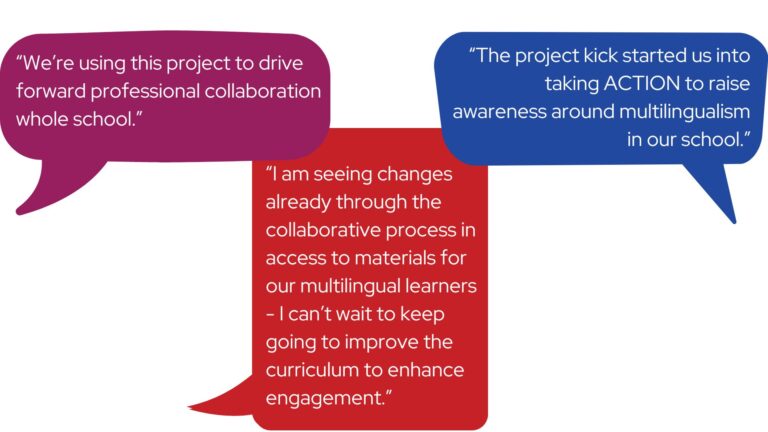
Three quotes in speech bubbles. “We’re using this project to drive forward professional collaboration whole school.” “The project kick started us into taking action to raise awareness around multilingualism in our school.” “I am seeing changes already through the collaborative process in access to materials for our multilingual learners – I can’t wait to keep going to improve the curriculum to enhance engagement.”
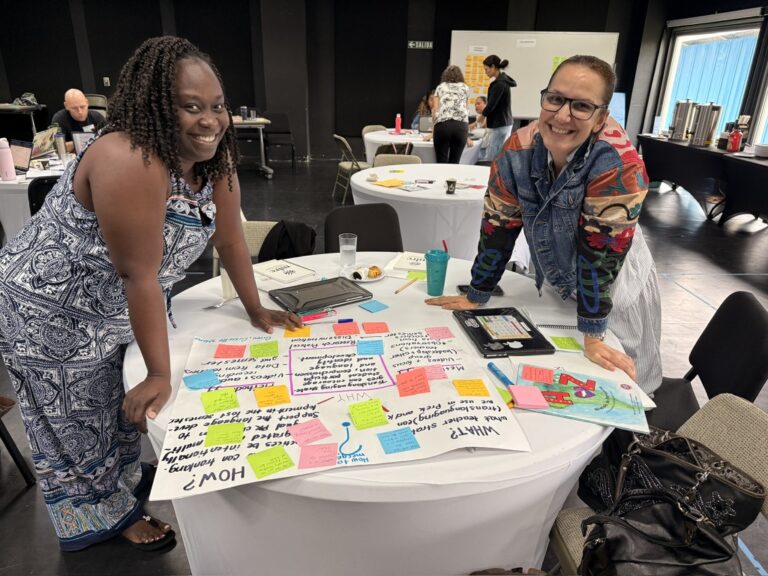
For many participants, they begin their action research journey through attending an in-person MLRC Research Symposium. Participants note how the symposium helped them acquire the practical tools they needed to begin action research, as well as the importance of providing a structure for the overall project. Others highlight the advantages of doing this type of work with a supportive community, as they were able to benefit from the expertise and questions of others across the region. After the conclusion of each MLRC Research Symposium, teams meet regularly with each other and with the MLRC team for additional coaching and support of their action research projects. In individual meetings and monthly meet-ups, teams share about their experiences and further develop their skills to engage in data collection and analysis. Learn more about the Research Symposium and upcoming dates and locations on our MLRC Research Symposium page.
Capstone Reports
Collaboration
- Frankfurt International School, Instructional Coaching for Language-Integrated Tier 1 Pedagogy in Multilingual Classrooms
- H-Farm International School, Building Collaborative Practices
- Hong Kong International School (Team 1), Spaces for Two Languages Collaborative Classroom Environments in DLI Programs
- International School of Beijing (Team 2), To what extent does participation in the ES PLC cycle improve Chinese teachers collaboration?
- International School of Beijing (Team 3), What collaborative co-planning framework can help homeroom and team teachers improve instructional clarity within the ISB DL team?
- Rabat American School, Exploring International School Teachers’ Beliefs and Pedagogical Change Regarding Explicit Genre-based Writing Instruction
- Suzhou Singapore International School, Designing Shared WIDA Support Tools to Strengthen Collaboration for Multilingual Learners
- Westlink International School, Sustaining co-planning in a highly multilingual international school
- American International School of Guangzhou, A Transformational Adult Learning Journey: The Development of a Bespoke Professional Development Program for Educational Assistants
- Hangzhou International School, Enhancing Reading Fluency with Microsoft TEAMS Reading Accelerator
- Hong Kong Academy, Engaging with WIDA: Co-Teaching Cycles: An Insight to Action Research
- Institut Formont, Co-creating bilingual writing booklets to enhance student writing skills and motivation
- Jakarta Intercultural School: Pattimura Elementary, Intentional Co-Planning Structures
- Ruamrudee International School, Collaboration between content and language teachers in HS science
Inclusive EAL
- Canadian International School Bangalore (Team 2), Inclusive EAL-Improving Student Fluency and Retelling Through Oral Reading Practices
- International School Bangkok (Team 2), The Benefits of Storytelling and Story Acting in an Inclusive/Multilingual Early Years Classroom
- International School of Beijing (Team 1), Conditions that Foster Agency in Multilingual Learners: A Descriptive Analysis
- Saint George International School of Madrid, How to support communicative skills in an EAL student with ADHD? An action research study on tools and resources in an international school context.
- Boston School and International Schools Partnership, How SEL Supports Achievement and Well-Being in Multilingual Learners
- Leysin American School, Supporting Neurodiverse Multilingual Learners With Academic Writing
- The International School Nido de Aguilas, One Size Doesn’t Fit All: How International Schools Navigate Dual EAL & LS Services
- Victoria Shanghai Academy, Vocabulary Acquisition: A Multilingual Perspective
Translanguaging
- Beijing City International School, Investigating Perceptions About Language in Lower Elementary Students: An Ethnographic Inquiry
- Canadian Academy, Translanguaging at Canadian Academy
- Canadian International School Bangalore (Team 1), Translanguaging: Surveying Our Current Context
- Claremont, Ecole Mosaic, Lady Elizabeth School, Coaching conversations and the use of the term translanguaging
- Institut Florimont, Professional Development Program: Supporting teachers in multilingual classrooms
- International School Bangkok (Team 3), Translanguaging in PreK
- International School of Beijing (Team 5), How do translanguaging pedagogies support multilingual middle school students’ sense-making in mathematics and science classrooms?
- Laude San Pedro International College, Do our multilingual students see their linguistic and cultural heritage as an asset or a challenge in our school environment?
- Park House English School, Perceptions of Home Language (HL) Status on HL Learning is KS2
- Ruamrudee International School, Translanguaging Practice at RIS
- Singapore American School, Language Bridging
- The American School of Asuncion, Deprivatizing Our Practice: The Influence of Peer Observations on Translanguaging Strategies at The American School of Asuncion
- The Hamilton International School, To what extent does access to daily Ed-Tech contribute to English Academic progress in Arabic A students who use main language of education (English) predominantly in school only?
- American International School of Guangzhou, Student Perceptions of Home Language Use in AISG’s Upper Elementary School
- Asociacion Escuelas Lincoln, Between Languages and Cultures: Exploring the Impact of Translanguaging on Local Staff in International School Environments
- Canadian International School Bangalore, An Account of Action Research Implementation at CISB 2024-25: Impact of Translanguaging by Content Teachers on Students’ Performances
- Cheongna Dalton School, Implementation of pedagogical translanguaging in homeroom classes (2-5) on students’ sense of belonging
- H-Farm International School Venice, Exploring Translanguaging in PYP and MYP
- Institut Fiormont, Translanguaging Strategies for Mathematics Education in Multilingual International Baccalaureate (IB) Classrooms
- Saigon South International School (Team 1), Understanding Language Ideologies at SSIS MS/HS
- Saigon South International School (Team 2), MLRC Action Research Capstone: Planning for Translanguaging
- The American School of Asuncion, Translanguaging at ASA – Measuring our depth
- The British School of Malaga (BSM) and British School Vila-Real (BSV), MLRC Action Research Capstone: Planning for Translanguaging
Members can see the complete list of Capstones on the Member-Only Hub.