
Strengthening the Educator Workforce for Multilingual Learners Toolkit
This tool is designed to guide local leaders in supporting pathways into teaching and retention of educators who provide high-quality instruction to MLs. This includes both teachers who focus on delivering targeted ELD services (and thus who obtain a specific certification or endorsement) as well as those who focus on providing academic content instruction and may not have a specific ML-focused endorsement. Because English development and academic instruction occur in both bilingual and monolingual programs, the tool is relevant for districts as they plan for educator pathways regardless of the program models in place.

Who Should Use This Tool?
We hope this tool will prompt meaningful discussions both within an LEA and between the LEA and external partners who are invested in developing and supporting the pool of teachers serving MLs. To that end, we recommend forming a working group that includes representatives from across the LEA. This group might include school administrators, ML directors, leaders of teacher preparation or alternative certification programs, and leaders of professional learning for educators of MLs.
We encourage including teachers in the working group and finding ways to incorporate the perspectives of caregivers and students. The group should have a designated leader—ideally the LEA director of MLs or someone in a similar role—who is responsible for overseeing the process. The leader should review all materials in advance to prepare for each meeting and ensure the workbook is completed as intended. Additionally, engaging an external facilitator familiar with the tools can add value by offering a “critical friend” perspective that may be difficult for internal facilitators to provide.
Getting Started: How to Use the Tool
This tool supports the development of a robust teacher pool to serve MLs through collecting and reflecting on data from five components (Figure 1).
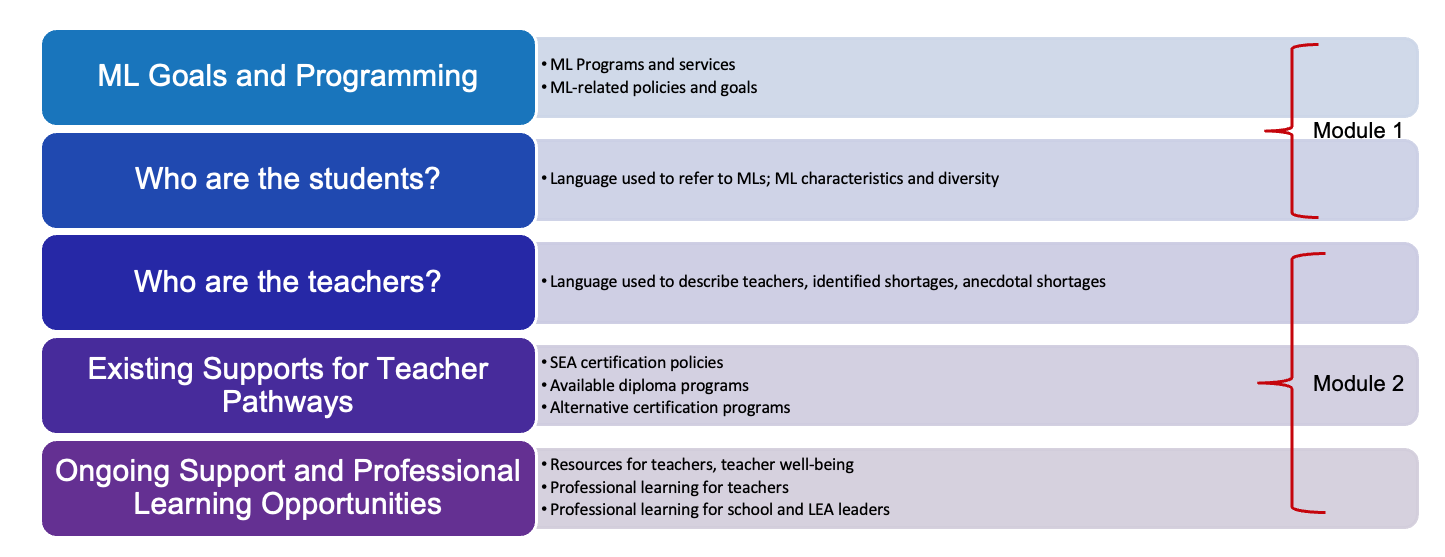
Figure 1. Components that contribute to building ML educator pathways
The tool process includes three modules (Figure 2), which provide an opportunity for the team to collect and reflect on data related to ML programs, students, teachers, and educator preparation.
- First, you will complete Module 1: Building a Vision for ML Programming in Your District.
This module looks at your current ML programming, identifies steps to take to align it with district-identified goals and sets goals for the rest of the modules.
- Next, you will complete Module 2: Existing Supports for Teacher Pathways & Retention.
This module focuses on building a shared understanding of the educational contexts of MLs in your LEA and then reviews current certification policies, preservice programs, and alternative certification strategies that support pathways into teaching as well as professional development and well-being supports that can promote teacher retention. You will consider the needs of ML students in your context and identify gaps between current practices and the needs of ML students.
- Finally, you will complete Module 3: Coming Together Around an Action Plan.
In this module, you will synthesize what you’ve learned in Modules 1–2 to develop actionable steps you can take to support the teaching workforce to better meet the needs of your ML students.
We encourage you to set aside substantial time to think through all the topics raised in the tool, but you may choose to do so in a way that works best for you and your colleagues. Each module includes pre-work (e.g., populating data tables with your LEA information) to be completed ahead of the session by at least one participant as well as content to discuss synchronously as part of a 2-hour session. However, you may adjust the content and timing of any module to better meet your needs.
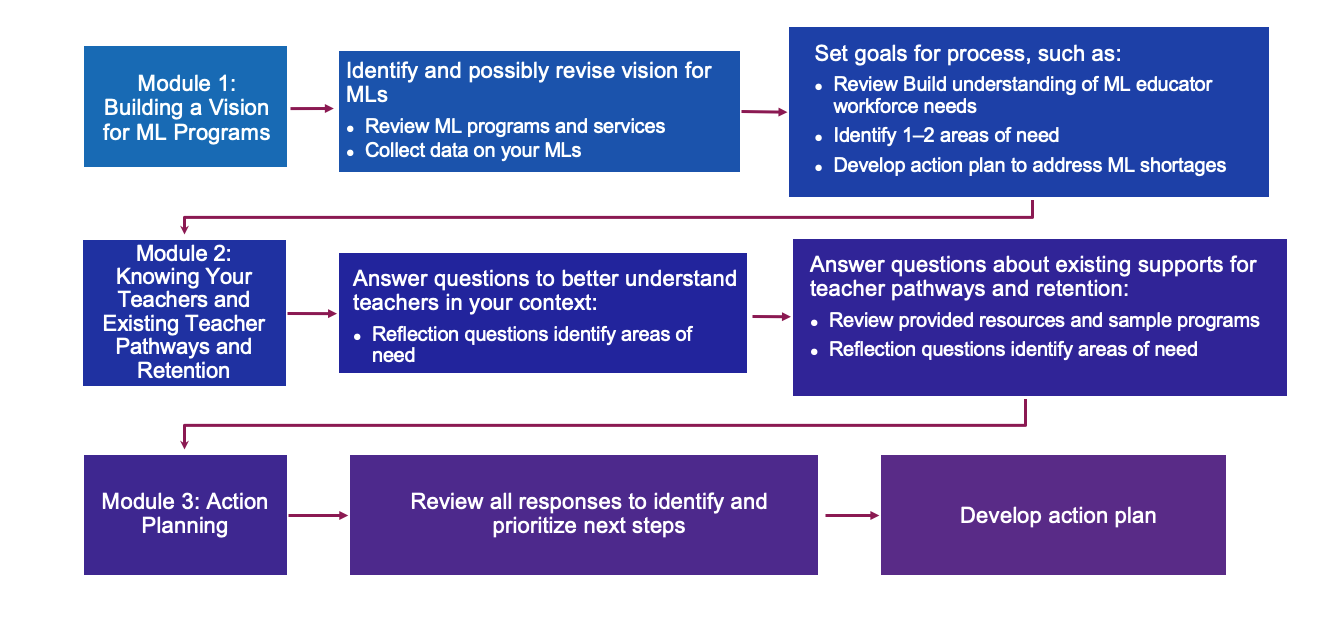
Figure 2. The Process
Each module includes three documents:
- Facilitator Guide includes step-by-step instructions for going through the materials and slide deck, as well as some additional resources that can be shared. While the Facilitator Guide provides all the content for the tool, we suggest that you have an outside facilitator who is familiar with the tools and can act as a critical friend for your team to provide additional supports for your team as you engage in this meaningful process.
- Workbook includes all the tables that will need to be completed. The Pre-Work Tables should be completed before the session so that all team members have access to the same information and data. The Think About Tables are opportunities for the team to jointly consider the implications of the data they have before them.
- Slide Deck is aligned to the Facilitator Guide and will be used during the session.
A Brief Look at Each Module
In this module, the district leader and the external facilitator will work with the district team and set goals for the work ahead. Together, they will examine state and district policies and frameworks as well as current ML programming and district vision for MLs and assess whether current ML programming meets student needs.
- Before your Module 1 session, the district leader and external facilitator should:
- Review the guides, slide decks and workbooks for all modules (1–3).
- Recruit team members who should participate in this work and list them in the table below.
- Determine how the team will collaborate through this process.
- How will you work within the workbooks?
- Will you use a shared drive for team access?
- Establish a timeline for the work
- When should pre-work be completed and shared with the team?
- If possible, pre-schedule the three sessions to approximately 2 hours each.
- Complete the pre-work (or assign it to team members) and bring any additional data that may support or align to your goals.
During the Module 1 session, you and the team will:
- Identify overall goals for using the tool.
- Finalize the list of participants.
- Review pre-work focused on (1) state and district policies/vision, (2) current ML programs and services, (3) information about the district’s ML students.
- Together consider and respond to the Think About questions.
After completing Module 1, you should have:
- Completed Module 1 pre-work data tables and Think About questions.
- A finalized list of strategic team members.
- A clear set of goals for using the tool.
- A description of district programs and how they align with your vision.
- Plans to complete pre-work for Module 2.
In Module 2, you will deepen your understanding of the teachers who serve your MLs. You will review current certification policies, preservice programs, and alternative certification strategies that support pathways into teaching, as well as professional development and well-being supports that promote teacher retention. This module will guide you to consider the assets that ML students bring to your district, how your current educators and educator pathways support your MLs, and areas you can change to improve the ability of educators to effectively teach MLs.
Before your Module 2 session, you should:
- Review the Module 2 facilitator guide and workbook and customize the Module 2 slide deck.
- Complete the pre-work and bring any additional data that may be useful and aligned to your goals.
- Recruit any additional team members identified as essential for this stage of the work.
During the Module 2 session you will:
- Review pre-work together.
- Consider and respond to the Module 2 Think About questions.
After completing Module 2, you should have:
- Completed Module 2 pre-work data tables and Think About questions.
- An understanding of how ML programs and services align or do not align with your students, how current teacher capacity aligns or does not with the district vision, and how future teacher pathways can address any gaps.
- A plan to review all work and findings before beginning Module 3.
In Module 3, you will synthesize what you learned in Modules 1 and 2 to develop concrete actionable steps that strengthen your teaching workforce and better meet the needs of your ML students.
Before your Module 3 session, you should:
- Review the Module 3 workbook and customize the Module 3 slide deck.
- Review the completed workbooks from Modules 1 and 2.
- Come prepared to revisit and if necessary, revise the original goals, and to collaborate on developing a clear action plan for implementation.
During the Module 3 session you will:
- Complete and finalize your action plan.
After completing Module 3 you should have:
- A finalized action plan ready for implementation, including short-term wins and next steps.