In international schools across the globe, demographic shifts are contributing to a change in the linguistic landscape, with more students who come to school speaking primarily the local language. How can schools respond to ensure their guiding documents align with both their values and the linguistic diversity of their changing populations?
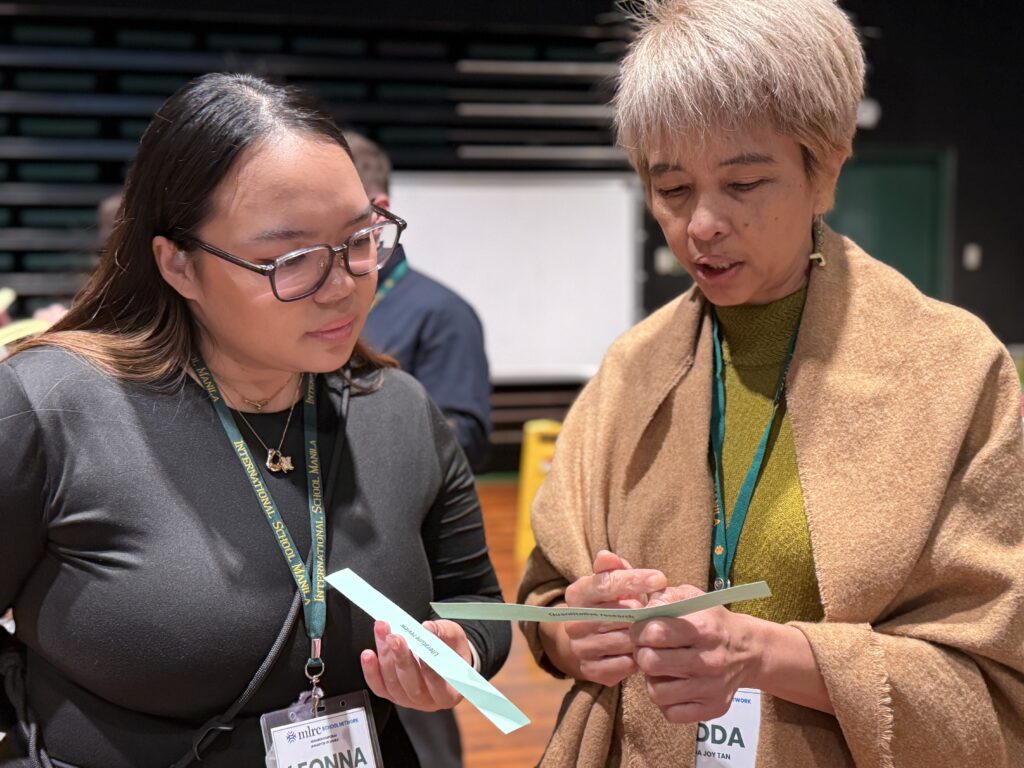
A school’s language policy can be developed as an essential document to guide this work and to communicate which languages are welcomed, valued, heard, and used in a school. Language policies typically address both language allocation (the “macro” rules about which subjects are taught in which languages) and language use (the “micro” daily decisions about how educators and students use language to communicate and make meaning). Ultimately, schools can develop language policies which promote the recognition and development of students’ full multilingual identities and practices.
The MLRC Language Policy Working Group formed in 2024 in response to an expressed need from MLRC School Network members for additional support to develop or revise their language policies to better serve their multilingual learners. Today, our group consists of participants from 36 schools representing countries around the world, working together to redefine how international schools approach linguistic diversity.
Policy as Empowerment: Opening Ideological Spaces
At the heart of our group’s work is a critical approach to language policy. We recognize that policies are not just top-down rules; they are deeply human processes. As Hornberger (2005) suggests, language policies can either open or restrict “ideological and implementational spaces” for multilingualism.
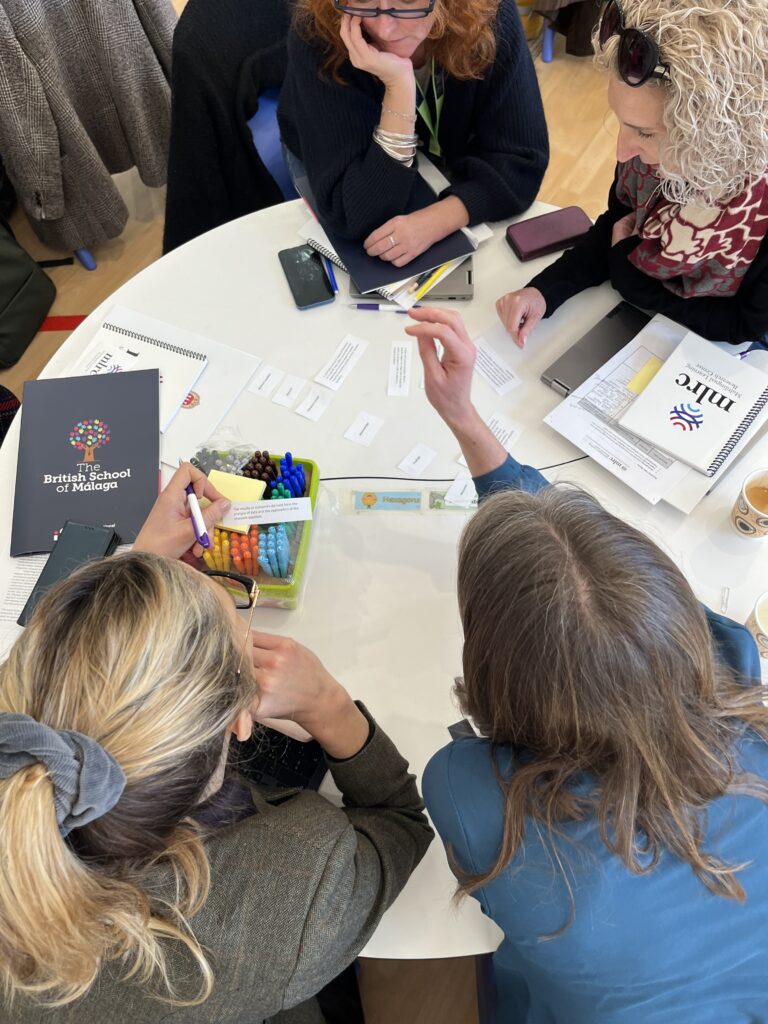
Additionally, international schools operate within a unique ecological framework that contributes to particular policy dynamics. While in many national systems, a teacher’s classroom practice is hemmed in by layers of district, state, and federal mandates, international schools often experience policy compression (Bettney Heidt & Nordmeyer, 2021). With the removal or blurring of those outer governmental layers, the distance between who writes the policy and who enacts the policy blurs or even disappears. As both policy-makers and policy-enactors, teacher leaders see the implications of policy “on the ground” and they can influence policy changes. By engaging in critical reflection, our group members are leading their schools in creating and enacting policies that carve out intentional spaces where students’ holistic language repertoires can thrive.
From Theory to Action: Developing Tools
Recently, our group published an article in the InterEd Journal. Drawing on key research and members’ personal experiences, we outlined seven stages of the language policy development process to be used by school leaders developing or revising language policies. While the full process moves from initial research to annual reviews, three areas are proving particularly transformative for school communities:
- Research & Information Gathering: This phase moves beyond surface-level observations to build a “school language profile.” By asking critical questions—such as “What languages does our school community use?” and “What resources exist in our library?”, schools ensure their policy is rooted in their unique linguistic ecosystem.
- Community Consultation & Preparation: True policy work requires shifting from merely being “aware” of diversity to treating families and students as active policy actors. By using inclusive strategies to gather input on language beliefs, schools can bridge the gap between administrative goals and the community’s lived values.
- Implementation: A policy is only as effective as its consistency in the classroom. We use “interest-piquing” protocols like the “Y” Chart—where educators brainstorm what a policy sounds, looks, and feels like in practice—to ensure the document becomes a lived reality. This includes building explicit systems for collaboration between language specialists and subject teachers, moving schools toward a shared responsibility for language development.
Since publication, we have heard from various school leaders who are applying the seven-step process, and group members have shared their own school’s language policy journey at various regional conferences.
Recently, our group launched its first collaborative research study. In the first phase, we have co-developed a rubric that draws on relevant research to outline key categories for evaluating a language policy. The rubric serves as a reflective tool to examine each school’s language policy and as an analytical tool for the study. We shared initial findings at the CLADES Conference (Belgium), as part of a comparative study on language policy with MLRC Co-Directors, Carrie Parker and Mariana Castro. This study contributes to an important gap; while the international school sector continues to rapidly expand, there are still limited empirical studies about supporting multilingual learners through equitable language policies.

The MLRC Language Policy Working Group began in response to an expressed need by members for additional support around a specific topic – language policy. The group has transformed into a thriving community of educators, representing schools at all different stages of their language journeys. We invite any members of the MLRC School Network to join our group so they can both benefit from and contribute to this important work! Reach out to mlrc@wcer.wisc.edu for more information or check out our brand-new page on the MLRC School Network Member Hub.
References
Bettney Heidt, E., & Nordmeyer, J. (2021). Language policy in international schools: A critical approach. International Schools Journal, 40(2), 54–63.
Hornberger, N. H. (2005). Opening and filling up implementational and ideological spaces in heritage language education. The Modern Language Journal, 89(4), 605–609.