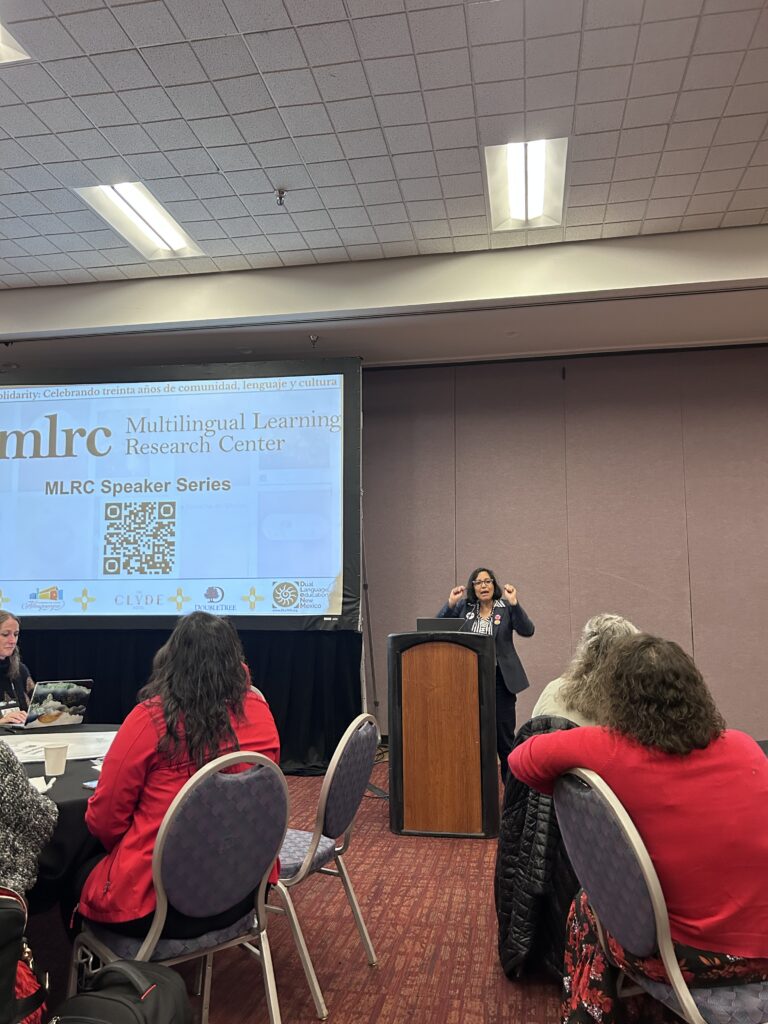
On November 13, 2025, at La Cosecha Conference in Albuquerque, New Mexico, Carrie and I joined other bilingual researchers to connect, plan, and continue to advance dual language bilingual education research. While La Cosecha has historically been a practitioner-focused conference, its organizers at Dual Language Education New Mexico have invested over the last few years to bring bilingual researchers together to develop a research agenda that sustains and advances dual language bilingual education (DLBE).
The DLBE research agenda includes a focus on teacher licensing, educator preparation, classroom and program practices, and policy, among other topics. If you want to read the DLBE agenda, click here. As dual language bilingual education programs launch and expand across the world, schools find themselves in need of evidence-based guidance to fulfill the promise of high-quality education, biliteracy, and global citizenship. However, many programs face challenges related to equity and access, staffing and professional development, program quality and availability of resources, and systemic and policy barriers. To solve these challenges, we need to move away from quick fixes and invest time and resources in deeply understanding sites of innovation to unlock the potential of dual language bilingual education. This is what the DLBE research agenda is about: high-quality research that unlocks the potential of dual language programs. As part of the MLRC, we are excited to contribute to this work through our research and our research-practice partnerships.
The main purpose of the researcher meeting at La Cosecha was to build the momentum of the DLBE research agenda. Researchers at the meeting connected to discuss vital timely questions in bilingual research and were inspired by the words of Dr. Socorro Herrera, a professor at Kansas State University and director of the Center for Intercultural and Multilingual Advocacy, which provides training for in-service and pre-service educators and fosters access and learning for all students. Leveraging her many decades of experience and expertise, Dr. Herrera made an inspiring call to action to researchers to focus research on the preparation of dual language bilingual teachers, who are at the heart of the work in advancing dual language education. Meeting participants then had an opportunity to brainstorm together critical content to include in next year’s full day Dual Language Bilingual Education Researcher Convocation, which will be held in collaboration with La Cosecha and will provide a space to explore research around key topics like bilingual programming, teacher certification, and instructional practices.
The dynamic session also included an opportunity to discuss and provide input to the upcoming project of the Center for Applied Linguistics to update their Guiding Principles for Dual Language Education. We also heard about other exciting work happening in DLBE, like that of Cambio Center focused on dual language education in the Midwest; the incredible ongoing work of TABE in Texas; the advocacy work of the National Dual Language Forum; and the activities of ICBERG, an international community of scholars committed to the advancement of bi-/multilingual education. Make sure that you check all these links!
If you are a bilingual researcher interested in participating in future research initiatives or learning more about the 2026 Dual Language Bilingual Education Researcher Convocation, make sure you join the DLBE Directory to connect with other researchers and receive updates about the 2026 DLBE Researcher Convocation, where we will get together to share, connect, collaborate, and continue to advance the DLBE research agenda. And if you want support in studying or improving your programs for multilingual learners, email us at mlrc@wcer.wisc.edu.