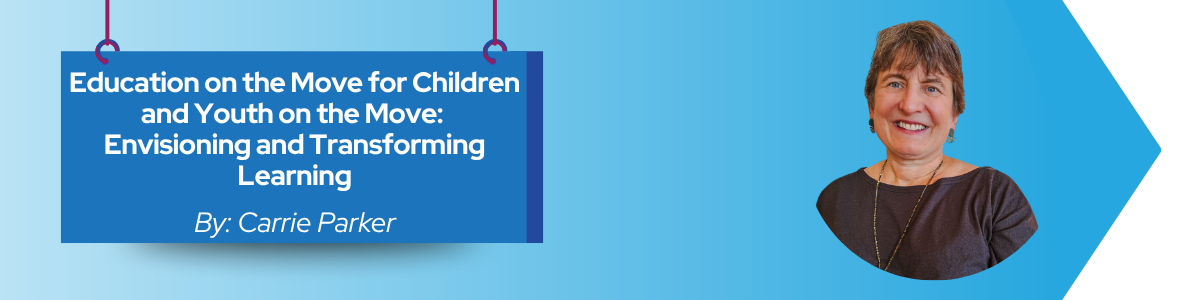
As an education researcher focused on improving schooling and learning experiences for multilingual learners, I have always been aware of the incredible diversity in the backgrounds of multilingual learners in US classrooms. Among them, students with limited or interrupted formal education (sometimes referred to as SLIFE students), come to US schools after months or years spent journeying in ways that have led to them not having access to formal schooling. Educators have worked tirelessly to develop high-quality instructional programs to support SLIFE students, to make sure they have access to both opportunities to learn English and to rigorous academic content.
This year we at the MLRC have an opportunity to conceptualize educational opportunities for children and youth who are in the midst of ‘becoming’ SLIFE students. These children and youth on the move (CYM) in Central America and Mexico, have left their homes (some unaccompanied, some with their parents or caregivers) and begun a process of moving through the region to find better opportunities. This work is more critical now than ever, because recent shifts in US immigration policies have transformed what was a linear, if extended, journey into a social space of waiting and forced immobility, and families now have to reorganize their daily life around this prolonged uncertainty (Pedone & Varela-Huerta, 2025). More youth are traveling unaccompanied by family members, up from 6.4% in 2025 to 15.5% in the first trimester of 2026 (UPMRIP, 2026), and more of them are girls; both factors that lead to increased vulnerability.
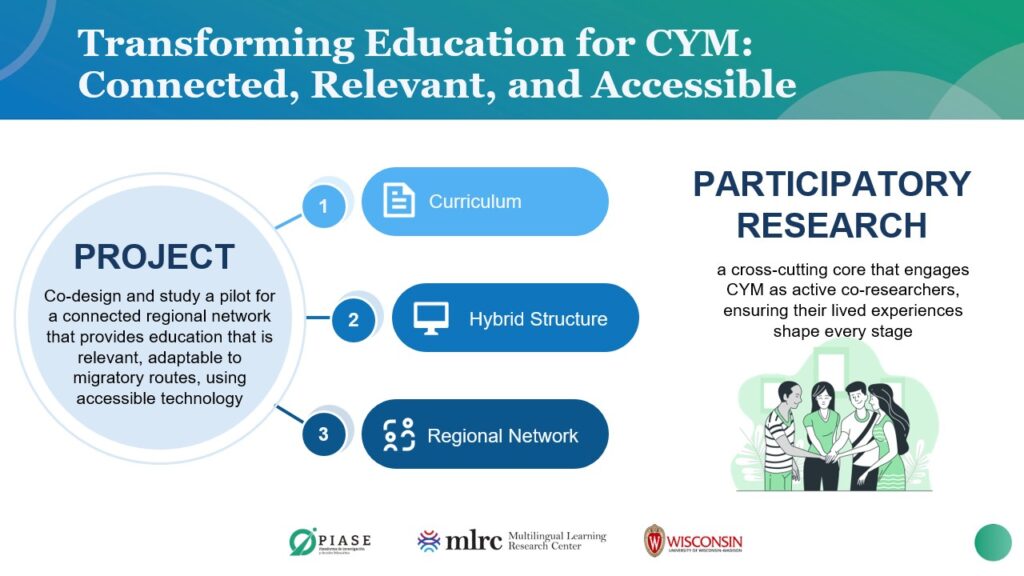
We are excited to announce that the Spencer Foundation has provided the MLRC and our partner, PIASE, a consulting and research organization focused on improving education systems across Central America and the Caribbean, with a one-year vision grant, Education on the Move for Children and Youth on the Move. Together, we will explore ways to transform educational services for CYM and ensure access to equitable, high-quality, and inclusive education. The grant will allow us to convene policymakers, practitioners, researchers, and CYM and their families to envision new educational opportunities for CYM. We envision a new networked educational system bringing together state, private and non-governmental organizations (NGOs) across Central America and Mexico: an educational program that moves with CYM so they can maintain educational progress regardless of where they journey.
We are working in four areas:
- Identifying components of a curriculum framework and design principles that center CYM experiences of border crossing, family separation and reunification, multilingualism, survival, belonging, and future-making, positioning these experiences as generative rather than limiting.
- Exploring online technology and regional hubs for both virtual and in-person learning.
- Designing a regional network that contributes infrastructure, shares information, builds connections, and considers cross-border accreditation.
- Conceptualizing a participatory research design for a pilot study that engages CYM as active co-researchers, ensuring their lived experiences shape every stage, and that examines relevance, feasibility, and impact.
As my Education on the Move colleague, Sonia Morin, has noted, “CYM are not leaving their homes due to a single cause, but rather to an accumulation of structural factors that make it ever more difficult for them to remain in their home countries. These factors include generalized violence, poverty, recurring economic crises, institutional weaknesses, forced displacements and climate change… their migratory trajectories occur in a context of great instability, with interrupted or fragmented education a fundamental aspect of migration.” The goal is to shift education for CYM from the current status of being fragmented, irrelevant, and inaccessible, to one that is connected, relevant and accessible.
References
Pedone, C., & Varela-Huerta, A. (2025). La familiarización de las migraciones en los corredores migratorios de América Latina: Una aproximación teórico-metodológica. Migraciones Internacionales, 16. https://doi.org/10.33679/rmi.v1i1.3197
Unidad de Política Migratoria, Registro e Identidad de Personas, Secretaría de Gobernación (2026). Niñas, niños y adolescentes migrantes en situación migratoria irregular, desde y en tránsito por México, 2026. Recuperado de: https://portales.segob.gob.mx/work/models/PoliticaMigratoria/CEM/Estadistica/NNA/NNYA_S%C3%ADntesis_ene-mar_2026.pdf