
Walk into almost any classroom, and you will see a learning objective on the board: “Students will explain how to multiply two fractions.” Learning objectives are specific, measurable, and attainable within the lesson of the day.
What will vary from teacher to teacher may be the interpretation. Take math, as one example. Some educators will focus on the conceptual understanding: Did the student understand that multiplying fractions is all about finding a “part of a part” rather than repeated addition as in whole numbers? Others may focus on the process: Did the student simplify the original fractions? Did they multiply the numerators across the two fractions? Did they multiply the denominators? Did they reduce the fraction?
If you work with multilingual learners, you probably realize that the language involved in learning also matters because, in the case of the example above:
- Language represents conceptual understanding: Understanding that multiplying fractions is finding a “part of a part,” rather than “groups of” makes a difference in how students make meaning of multiplication of fractions.
- Language expands cognitive capacity: When you learn new language, like “numerator” and “denominator,” you gain precise tools for analyzing information and conceptualizing abstract ideas.
- Language fosters empathy and connection: When students learn how to contribute ideas and invite others into the conversation while working in small groups to solve math problems, they gain agency and self-awareness and build connections with peers.
- Language is a social and professional tool: As students learn how to communicate with peers, they develop new and strengthen existing social relationships, while also preparing them to participate in professional settings.
While we can all agree on the importance of language in schools in support of complex thought, language objectives, the language objectives used to guide language development, often lack similar complexity, focusing primarily on vocabulary.
A robust language objective should blend certain core elements into a single statement:
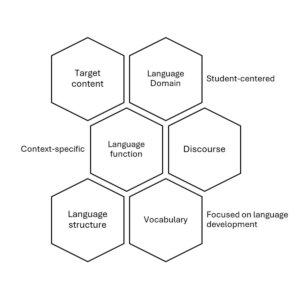 Target Content: Ties the language directly back to the content objective and is the basis of content and language integration.
Language Domain: Specifies whether students will be reading, writing, listening, or speaking. Ideally, language objectives address all language domains and account for multiple modalities in learning beyond the traditional four domains mentioned above.
Language Function: Uses an active verb to define how students process or communicate information (e.g., compare, justify, sequence, summarize, analyze).
Language feature: Provides specific elements of language to focus on: discourse (how sentences connect coherently to form texts, conversations, lectures, or narratives), language structures (grammar and syntax that connect words to form sentences), and vocabulary (the use of specific words or phrases).
All of these elements are selected to build on students’ strengths to help them develop language. They are also chosen depending on the specific context of the classroom where students learn, taking into account grade level and the full range of students’ experiences.
So, next time you are about to write a language objective, remember it should include more than words. Think of language objectives as the building blocks for constructing complex thought.