Stiftung Louisenlund is a future-oriented, boarding and day school in northern Germany that understands education as far more than “just” school. Rooted in the educational tradition of Kurt Hahn, Louisenlund accompanies young people on their journey toward becoming responsible, self-determined individuals. Education is understood as a holistic process – individualized, competence-based and closely connected to real life. As a boarding school, Louisenlund provides a living and learning environment in which this holistic development takes place around the clock: in formal learning, in the community, in everyday life and through engagement with oneself and others.
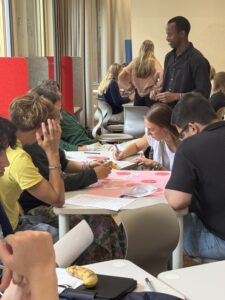
At the heart of Louisenlund’s mission is personalized education and the belief that every young person learns differently and has individual potential to develop. Small learning groups, committed mentors, modern learning spaces and a reflective use of digital opportunities create a universe of possibilities in which individual learning pathways can unfold. Teachers are therefore more than providers of knowledge: they are mentors, companions, and role models who build strong relationships with students and support their academic, personal, and social development.
Education at Louisenlund means developing potential, strengthening character and experiencing participation. Students are encouraged to take responsibility for their own learning and for others, to help shape their environment and to find meaning in what they do. Learning is designed to develop future-oriented competencies and to nurture young people who think critically, act creatively, collaborate effectively, take initiative, and understand themselves as responsible members of society. In this sense, Learning, Achieving, Living is both daily practice and a shared aspiration across the Louisenlund community.
The IB World School at Louisenlund is accredited by both the International Baccalaureate (IB) and NEASC-CIE. It offers the Middle Years Programme (MYP) and Diploma Programme (DP) and brings together students and educators from Germany and around the world. Multilingualism is consequently a natural and valued part of the community. English is the principal language of instruction within the IB World School, while students bring diverse home languages, linguistic biographies and cultural perspectives to their learning. At the same time, international students learn German through dedicated language classes and have many opportunities to use the language authentically in Louisenlund’s wider, predominantly German-speaking boarding community. Language development therefore extends beyond the classroom into boarding life, activities, projects, sports, friendships, and everyday interactions. This reflects Louisenlund’s holistic understanding of education: learning does not stop when a lesson ends, and neither does language learning.
What makes Louisenlund distinctive is the way multilingual learning is embedded within a broader pedagogy of personalization, agency, relationships, belonging and holistic development. Rather than viewing multilingual students primarily in terms of their proficiency in the language of instruction, Louisenlund seeks to recognise each learner as a whole person whose languages, cultural experiences, interests, and identities are valuable resources for learning and for the community. Students in the IB World School learn primarily in English while developing German through dedicated language learning and authentic participation in the wider life of the boarding community. At the same time, the international composition of the IB World School means that multiple languages, cultures, and perspectives are part of students’ everyday experience. The boarding school environment offers particularly rich opportunities for this approach. Louisenlund understands the entire campus and community as a learning environment. A multilingual learner may develop German formally in a language lesson, use it informally over lunch, practise it through sport or a co-curricular activity, and build confidence through friendships and everyday interactions with German-speaking peers and adults. In this sense, multilingual development is both an academic and a social process closely connected to participation and belonging.
The Louisenlund Pedagogy provides further opportunities for personalized multilingual learning. Flexible learning structures, small learning groups, mentoring, independent studio time, reflection, authentic learning experiences and the flexible use of time and space allow support to respond to individual learners rather than expecting every student to follow the same pathway. Student agency is particularly important. Young people are encouraged to shape their own learning paths, set goals, reflect on their progress, make meaningful choices, and increasingly take responsibility for their learning. Through structures such as the Student Leadership Board and the Leadership for Impact programme, IB students also contribute actively to shaping their school and community. This creates an important opportunity for multilingual education: rather than developing support for multilingual learners alone, Louisenlund is interested in exploring how approaches can increasingly be developed with them, drawing on their voices, experiences and linguistic resources. Ultimately, this reflects Louisenlund’s conviction that education should not standardize but strengthen the individual. Linguistic diversity is therefore not regarded simply as a challenge to overcome, but as part of the diversity of experiences and perspectives from which the entire learning community can benefit.
Louisenlund joined the MLRC School Network because its research – practice approach strongly resonates with the school’s understanding of learning and educational development. Louisenlund sees itself as a learning organization: educational practices should not simply be implemented, but continuously questioned, reflected upon and developed on the basis of evidence and the experiences of learners and educators. The MLRC School Network provides an opportunity to connect this culture of reflection and innovation with a global community of researchers and practitioners committed to improving learning for multilingual students. Its collaborative approach is particularly aligned with Louisenlund’s belief that meaningful educational development emerges through dialogue, participation and co-creation rather than through standardized solutions. The opportunity to participate actively in it is therefore particularly valuable. Through the MLRC School Network and the action research project, Louisenlund can investigate an authentic problem of practice, learn alongside researchers and educators from other international contexts, and contribute its own experiences to the wider research-practice partnership. This reflects a central principle of Louisenlund’s mission: learning is most powerful when individuals actively participate in shaping it. The school hopes to bring this same principle to its collaboration with the MLRC through learning with and from others.
Louisenlund hopes to use its participation in the MLRC School Network to deepen its understanding of multilingual learning through the lens of its own pedagogy and, importantly, to challenge assumptions about what effective support for multilingual learners can and should look like. One area of particular interest is the relationship between language, learner agency, and belonging. Louisenlund would like to explore how multilingual students can be supported not simply to access learning in English or develop proficiency in German, but to draw confidently on their complete linguistic and cultural repertoires as learners and members of the community. A central question is how the principles that already shape the Louisenlund Pedagogy can be applied more intentionally to multilingual learning. How can personalization, mentoring, reflection, flexible learning time and authentic learning environments better support individual language development? How can multilingual learners develop greater agency in setting their own language-learning goals and identifying the strategies and environments that support them? And how can students themselves contribute to designing the structures and practices intended to support their learning? The school is also interested in exploring the relationship between language learning and life in the community. Louisenlund’s boarding context offers opportunities that extend far beyond formal language instruction.
International students learning German live alongside German-speaking peers, participate in shared activities and projects, and encounter the language throughout everyday life. Louisenlund would like to understand more systematically how these authentic interactions contribute to language development, confidence, participation and a sense of belonging – and how the school can make better use of this potential. Another important area of inquiry concerns the role of all educators in supporting multilingual learners. If learning is understood as a holistic process that takes place across subjects, spaces, and relationships, multilingual learning cannot be the responsibility of language teachers alone. Louisenlund is therefore interested in exploring how subject teachers, mentors, boarding staff, peers, and the wider community can contribute to an environment in which multilingual students can flourish. In this sense, multilingual education connects directly to Louisenlund’s wider educational ambition: to create a community in which diversity strengthens rather than separates, in which young people experience genuine belonging, and in which every learner has the relationships, agency, and opportunities needed to flourish and make a positive impact.