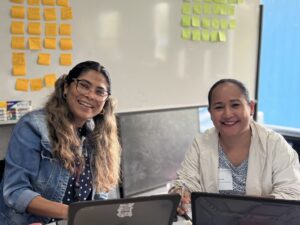
Research allows us to think more systematically, but at times research may feel disconnected from educators’ daily experiences in their classrooms and schools. Too frequently, we do not connect the wisdom of practitioners with the tools of inquiry that can close this “gap” between research and practice. At the MLRC we have designed a research-practice partnership to help teachers leverage their professional insights. Co-director of the MLRC Mariana Castro captured why we do what we do:
“Multilingual learners use language to connect with their families, but as they step out into the world, they may experience language in other ways: printed on signs, heard on the streets, or during online interactions. When these children arrive in our schools, they bring with them all those experiences of language use. Our job, as educators, includes helping them use that knowledge and experience with language in their learning, as well as expand on it so that they are able to enter new spaces and language in ways yet to be discovered” (Castro 2020, p.2).
We know that teachers are working hard to do this all the time, and that powerful learning opportunities are embedded in the ecosystems teachers inhabit daily. While building on multilingualism as an asset, teachers experiment with and develop teaching practices yet to be discovered. Committed to improving outcomes for MLs, teachers gather, organize and analyze student data as evidence of learning. A sociocultural perspective recognizes that we all learn by engaging with others across multiple communities, both within schools and across schools.
Action research holds the promise of helping educators answer their own questions. Using tools of systematic inquiry forces us to take a step back and see our own contexts with new eyes. We build and test hypotheses with locally generated evidence. Taking a moment to reflect, and not rushing to “solutionitis” helps us to describe things as they are, not as we think they ought to be. As we observe, gather and analyze new evidence, we can test and refine our mental models and theories about teaching and learning within our own ecosystem. These mental models help us evaluate our teaching practices – to amplify, discontinue or experiment with new practices – to improve classrooms for MLs.
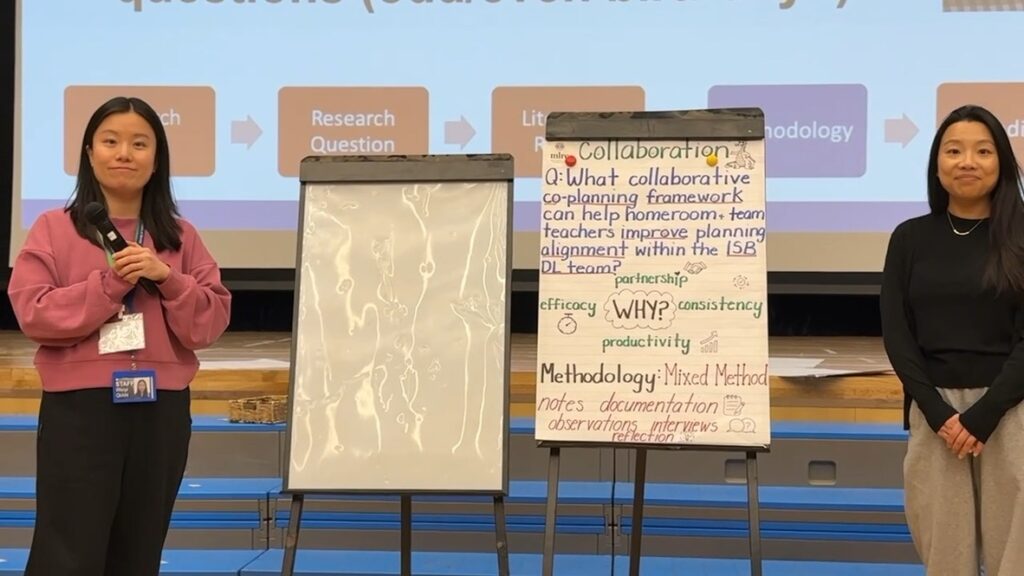 We see teachers and leaders doing the work of schooling: caring for students, designing learning ecosystems. Running from planning to teaching to lunch duty to meetings and after-school activities – opportunities to reflect on learning or share insights with colleagues may be hard to find. We designed the MLRC Research Symposium with that reality in mind, and designed a process to help teachers recognize, clarify and amplify their day-to-day insights. In scaffolding action research, we have tried to create the opportunity for us all to get smarter together.
In the past month, we have joyfully received Capstone reports from around the world. It is gratifying and inspiring to see the inquiry and insights embedded in each report. Teams reflected on what they learned about a problem of practice, or noted a surprising discovery from their data, or in some cases a new and compelling research question:
“Engaging in the research process deepened professional dialogue across the school… helped make instructional decisions more intentional and visible… [and] allowed us to see how small adjustments in scaffolding can significantly impact student participation and confidence.” (H-Farm International School Venice)
Connecting research to practice can have a profound impact. We have seen that when teachers learn together about how to serve MLs, this increases pedagogical self-efficacy: their confidence in their own competence in teaching MLs.
“The inquiry cycle has strengthened the structure and effectiveness of team collaboration by creating clearer meeting routines, shared goals, and more purposeful discussions centered on student learning… We also feel empowered to help develop our program and make positive changes within our department.” (International School of Beijing)
When teachers learn how to use insights from research as well as data gathered in the local context, their increase research self-efficacy: their confidence in their own ability to engage with and in research.
“I learned that action research requires patience and adaptability, as the findings are not always straightforward and often reveal complexities that were not initially anticipated. Perhaps most importantly, the experience reinforced my belief that teachers can be researchers and that practitioner inquiry has the potential to influence classroom practice, professional learning and whole-school improvement.” (Lady Elizabeth School)
We recognize the educators spending an entire day leading learning and then taking the time to think deeply about might make a difference for students. As we look back on three years of learning together with teachers around the world, we reaffirm our own commitment to collaborating with teams through action research. We look forward to developing new ways to help teachers discover, design and deepen practices that allow multilingual learners to thrive.
As you enjoy a welcome pause over the next few months to reflect, relax and recharge – we hope you’ll take a moment to celebrate with us the insights and inspiration teams have shared in their MLRC capstones. Literally spanning the globe, we applaud these educators who have connected research to practice, in ways that matter for students.